

The essential function of a trademark is to indicate trade origin and enable consumers to distinguish one trader’s goods from those of another. However, the accelerating effects of climate change challenge this assumption. Changes in the environment caused by climate change are changing how materials, products, and natural inputs look. This raises a big question: what happens when nature itself “rebrands” a product?
This blog argues that climate change destabilises colour-based trademarks by undermining the doctrines of distinctiveness and non-functionality, thereby exposing gaps in Indian trademark law.
The Law of Colour Trademarks in India
Under the Trade Marks Act, 1999 (“Act”), a trademark may include a combination of colours, provided it is capable of distinguishing goods or services. In Colgate Palmolive Company v Anchor Health & Beauty Care Pvt Ltd, the Delhi High Court recognised that a colour combination (red and white) can be registered as a trademark. Yet, it emphasised that protection depends on acquired distinctiveness and cannot extend to colours per se in the abstract. Similarly, in Christian Louboutin Sas vs Abubaker & Ors, the court upheld the trademark in the red sole of a shoe.
The legal foundation for colour trademarks in India rests on two key definitions in the Act. Section 2(1)(m) defines a “mark” to explicitly include a “combination of colours” and Section 2(1)(zb) defines a “trade mark” as a mark capable of being represented graphically and capable of distinguishing the goods or services of one person from those of others. The statute explicitly mentions a combination of colours. While registering a combination of colours, it is straightforward if it acts as a unique identifier, registering a single colour is exceptionally challenging. A single colour lacks “inherent distinctiveness.” Therefore, the entire legal battle revolves around proving acquired distinctiveness (often called “secondary meaning” in IP jurisprudence).
Climate Change and Colour Degradation
Numerous studies were conducted earlier, which clearly show that climate change exacerbates the colour degradation, resulting in a change in the colour of the products. To illustrate this issue, consider a hypothetical scenario where a specific colour registered and heavily relied upon for brand identity, physically morphs over time due to environmental exposure, leaving the brand owner with a trademark for a colour that their product no longer retains in the real world.
Consider the hypothetical of a sustainable outdoor brand “Aura Indigo”, that successfully trademarked “Aura Indigo”, a specific, non-functional deep blue for its tents and jackets that consumers instantly recognise. However, accelerating climate change is disrupting this trademark. Unprecedented UV radiation and shifting climate patterns disrupt the organic dye’s agricultural supply chain, fundamentally altering its baseline chemical composition. Consequently, within just one year of outdoor use, the iconic “Aura Indigo” photochemically degrades into a faded, mottled violet. Therefore, “Aura Indigo” is being forced to abandon its established goodwill in the original colour, creating a gap in protection while the new colour acquires secondary meaning, and is financially impractical for a continuously shifting spectrum.
United States trademark jurisprudence has already initiated a similar shift from static rigidity to dynamic resilience through its recognition of “Fluid Trademarks.” The United States Patent and Trademark Office (USPTO) and federal courts have increasingly recognised that trademarks may undergo limited evolution over time, provided that the modified mark continues to create the same commercial impression and preserves its source-identifying function.
Fractures in the Framework: The Three Dilemmas
This environmental degradation exposes three critical gaps in trademark doctrines, particularly within frameworks of the Act:
- The Crisis of Acquired Distinctiveness: Trademark law protects the registered mark. If millions of consumers begin encountering Aura’s tents in the wild as “faded violet” rather than “Aura Indigo,” the public’s mental association shifts. If a rival company starts manufacturing tents in that exact faded violet, can Aura sue for infringement? The brand risks losing its distinctive character because the “stable” trade identity has been overwritten by nature.
- The Failure of Graphical Representation: Under Section 2(1)(zb) of the Act, a mark must be capable of being represented graphically. A single Pantone shade is easy to represent. But how does a brand graphically represent a colour that is guaranteed to degrade along a specific spectrum over time? Current trademark registries are built for static identifiers, not dynamic, living colours that change with the climate.
- The Functionality Trap: To save their trademark, Aura might attempt to halt the degradation by switching from their organic dye to a heavy-duty, synthetic, UV-resistant chemical coating to lock in the “Aura Indigo.” However, if this new chemical coating inherently improves the UV-resistance or thermal insulation of the tent itself, the colour suddenly becomes tied to a utilitarian function. Under the doctrine of non-functionality, a colour that improves the product’s performance cannot be trademarked. Therefore, Aura is trapped between allowing nature to alter its trademark or fixing the colour and risking invalidation due to functionality.
The difficulty, however, lies in the relationship between the colour mark and the protective coating. Although the coating is separate from the trademarked colour, preserving the registered appearance of “Aura Indigo” now depends upon its application. If the coating also enhances UV resistance, thermal insulation, or durability, it becomes a functional feature of the product. Protecting the colour only when maintained through such a coating risks indirectly extending trademark protection to a utilitarian feature, contrary to the functionality doctrine, which prevents trademark law from granting perpetual exclusivity over product features that improve performance. Aura is therefore caught in a dilemma: allowing the colour to fade risks losing its distinctiveness, while preserving it through a performance-enhancing coating may invite challenges that the protection of the colour mark effectively depends upon a functional product feature.
Changing Laws for Changing Environment
It is evident, therefore, that our own law on trademarks needs reform. Such reform is best presented in four prongs –
- Recognition of Dynamic or Fluid Colour Marks: Currently, non-traditional trademarks accommodate motion (like a GIF) or holograms. Therefore, it is suggested that registries need to expand this to include “transitional colour marks.” Instead of registering a single, frozen Pantone shade, a brand could register a specific degradation spectrum (e.g., “Pantone 282 C transitioning to Pantone 258 C over a 24-month exposure period”).
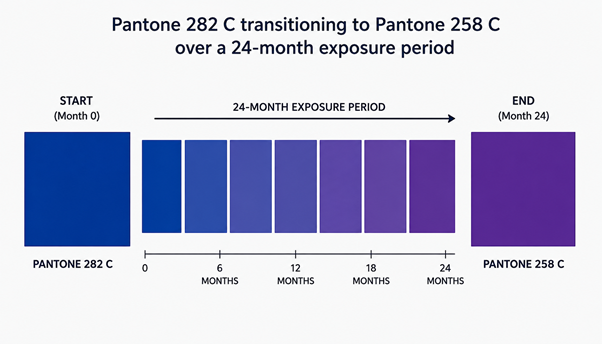
- Updating Graphical Representation Requirements: The law could allow brands to submit scientific degradation charts or time-lapse representations alongside their applications. If a colour change is predictable and scientifically verifiable, that predictability becomes the distinctive graphical representation.
- Sustainability Exemption for Functionality: The functionality doctrine might need a modern carve-out. If a brand uses an organic, climate-vulnerable dye specifically to meet environmental regulations or sustainability goals, the law shouldn’t punish them. Conversely, if they add a chemical stabiliser purely to preserve their trademarked colour, courts could view this as protecting brand identity rather than adding a “utilitarian function” to the product itself.
Although no reported decision has considered whether a climate-adaptive protective coating applied to preserve a trademarked colour constitutes a functional feature, existing functionality jurisprudence demonstrates that courts deny trademark protection where the claimed feature performs a utilitarian role. In TrafFix Devices, Inc. v. Marketing Displays, Inc., the United States Supreme Court held that features essential to the use or purpose of a product cannot receive trade dress protection. Likewise, Qualitex Co. v. Jacobson Products Co. recognised that colour marks lose protection where the colour itself provides a utilitarian advantage. These cases do not address climate-adaptive coatings directly, but they illustrate the doctrinal risk that, if a protective coating materially enhances durability, UV resistance, or product performance, courts may characterise it as functional rather than purely source-identifying.
- Expanding Acquired Distinctiveness to the Lifecycle: Courts must reconcile this by recognising that consumers interact with products over years, not just at the point of sale. If a brand can prove that consumers recognise the faded version of their product just as strongly as the new version, the legal protection could extend across the product’s entire lifecycle.
This reform is not about changing the standards but about redefining protection itself. To further harmonise the process, the authorities can consider scientific reports on colour changes due to changes in UV radiation or temperature and make a reasonable accommodation based on future calculations. In addition to this, the courts can also make a list of substances/dyes which can be used for preserving the brand identity on which the trademark can be allowed.
Conclusion
If our environmental reality is changing, then our legislation needs to keep pace with these changes. Although trademarks based upon colours are still relatively new in the field of intellectual property. Legal adjustments are essential to ensure that such protection incorporates climate adaptation techniques. This adjustment would strengthen the trademark laws in our country and guarantee that it provides significant social and economic advantages to the public.
Authored by: Mr. Shreyansh Raj, National Law School of India University, Bengaluru
Mr. Shreyansh Raj is a second-year B.A., LL.B. (Hons.) student at the National Law School of India University, Bengaluru. His interests include intellectual property law, technology law, corporate law, and public policy.