
“Off Campus”, the new hockey romance series released on Prime Video has been extremely popular and gained viewership of 36 million people within just a fortnight. This new book-to-series adaptation has become viral on social media, with several A-list actors and musicians speaking up about it. One of the most popular scenes for viewers is the scene where Allie, the main character’s best friend, wears the iconic forest green JLo dress while JLo’s “Get on the Floor” plays in the background.
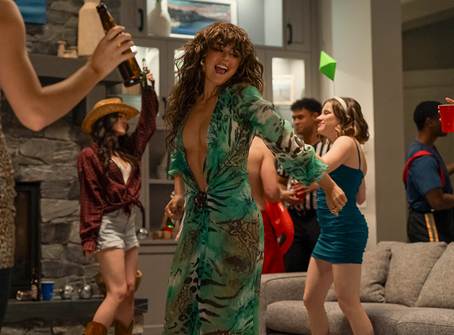
Liane Hentscher [Prime]
Jennifer Lopez herself states in an interview that she loves how the song has again climbed the charts because of the Off Campus scene, but that she had no idea it was going to be used in the show. The Off Campus show had cleared the usage of “Get on the Floor” with JLo’s record label, and did not personally ask JLo for permission to use the song. Similarly, two other prominent musicians – Sombr and Emei – had also stated that they were unaware that their respective songs were going to be used in the series. This raised concerns regarding whether Off Campus had gained the necessary rights to use these songs in their show, and secondly whether it was ethical for the permission to be granted by the record label representing the artists, and not the artists themselves. This debate is essentially discussing music licensing, and the rights and protections that the artists have against the unlawful usage of their musical works.
For any show or series to have permission to use a particular recording of a song, they must have 2 separate licenses – the sync license and the master license. The sync license grants the permission to use the musical composition of the song, while the master license provides the permission to use a specific recording of the song. Many artists tend to transfer these rights of master license to their record labels. So the record label can bypass the artist’s opinion, and can grant the rights to use a particular song themselves. However, this raises the concern of whether artists have adequate protections against the unilateral action taken by the record label with regards to their music.
What measures can artists take to protect their music from being licensed by their record label? Do these measures differ from country to country? Does India have a statutory law that protects artists in such situations?
To answer these questions, let’s decipher the country of production for the Off Campus show. Off Campus was produced and created in the United States. So the field of law can be narrowed to the law in the United States with regards to music licensing. In the US, there are no federal laws that uniformly govern music licensing all across the country, so these laws can differ from state to state. For example, in California, the “California Talent Agency Act” sets out the rules and regulations to protect artists in the entertainment industry. But what measures can artists in the US take, when there is no state law that is protecting their work? If artists want to hold greater control over the usage of their music, they must ensure that rights regarding the licensing of music remains with them while signing a contract with their record label. Although, even when the contract is fine-tuned to grant greater control to artists, this is oftentimes not effective in reality. For example, in the Jonny Greenwood case, Greenwood was arguing that his contract with Universal ensured that the label was mandated to consult with him when licensing his music to others. However, consultation rights do not equate to licensing rights, and artists should negotiate for the latter while signing their contracts early on in their journey with a label. If this crucial negotiation is not done, artists can not terminate the transfer of their music rights to the label- unless a period of 35 years has passed. This limited protection to artists after such a vast period of time, highlights the meagre and undeveloped state of statutory laws with regards to artists having greater control over licensing in the US.
In comparison to the US, India provides more protections for artists to control the use of their work in the entertainment industry. The Copyright Act of 1957, which was amended in 2012, provides several rights for artists and additional recourse in case their rights were harmed. Under this Act, royalty rights have been made “non-waivable”. This means that record labels cannot keep the royalties earned from an artist’s work all to themselves, and the artist will also have an equal share in receiving such royalties. So, when an artist’s work is used in a film without their permission but with the consent of their record label- they will still earn royalties from such usage of their work. In the IPRS vs Vodafone case, the Calcutta High Court held that royalty rights can not be transferred by the label single-handedly, and artists will be protected by section 18 and 19 of the Copyright Act. Apart from this protection, artists can also terminate the licensing rights under their contract after 5 years – and do not have to wait for 35 years to conclude, in order to regain their rights.
So, as an artist, the protections and rights granted to you will differ based on your country of citizenship. Regardless of your citizenship, it would be practical to negotiate for greater control over your work while signing a contract with a record label. Additionally, ensure that you are granted both licensing rights and royalty rights – as that will ensure protection of your reputation and integrity, as well as ensure your economic well-being when your work is used for online media productions.