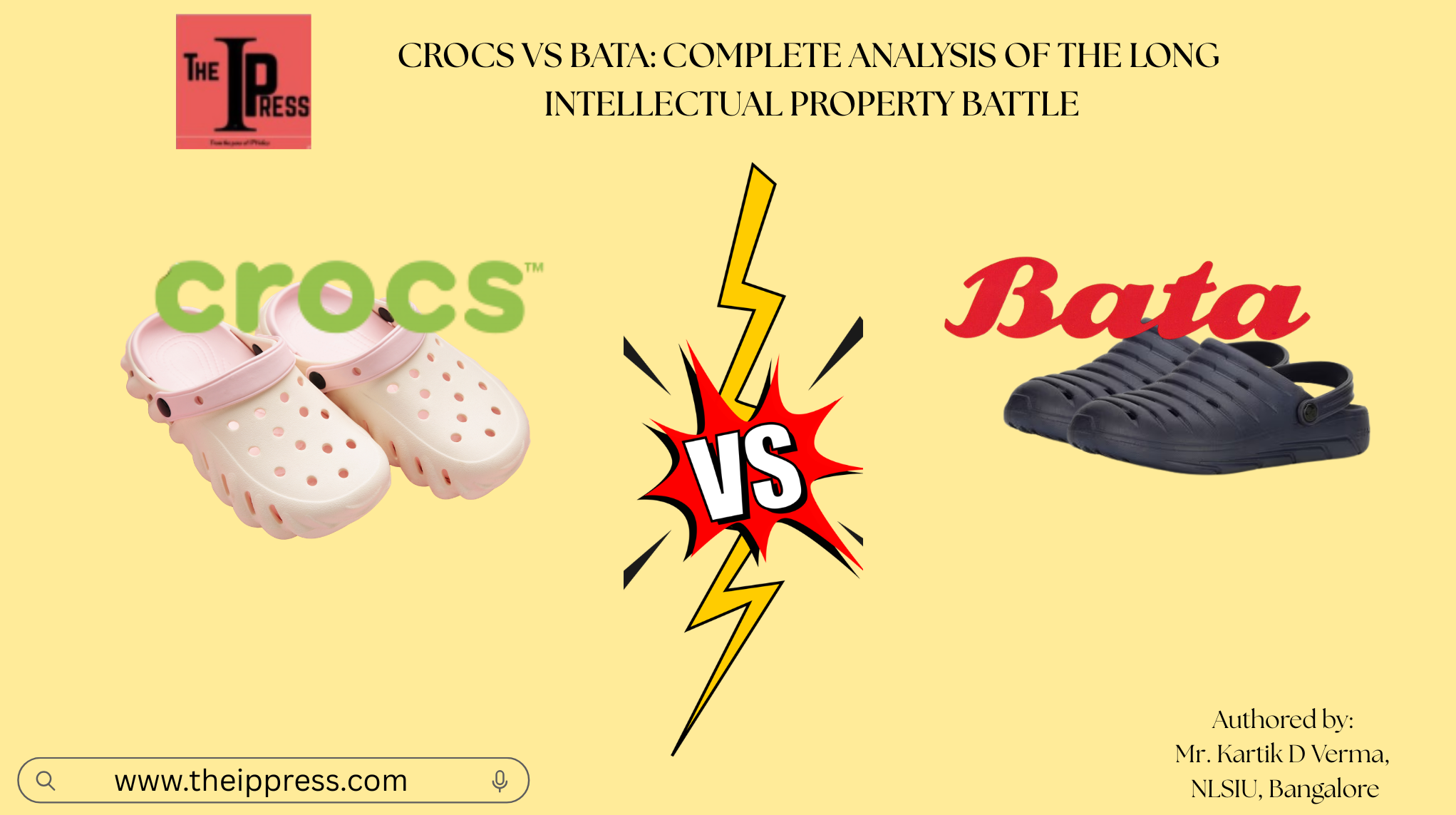
Your logo can be protected forever, a trademark once registered and renewed under the Trade Mark Act 1999, never expires. Your product’s shape usually can’t. The Designs Act, 2000 gives it a strict 15-year window, then it’s fair game. But what if a shape becomes so recognizable that customers associate it with you the way they associate a logo with you? Does it quietly graduate into something that never expires?
This question led to a decade long litigation between Crocs and Bata and other Indian foot wear brands . On 9 July 2026, the Delhi High Court ordered Crocs Inc USA to pay Bata India ₹24.63 lakh in costs, closing a battle that started in 2014. This is the least interesting part of this story. The real story is what the case reveals about a gap in Indian IP law that no one has fully closed and what that means if you’re the one deciding how to protect a product’s look.
Key words : Passing off , Trademark , Designs, Design trademark overlap, functionality doctrine.
Procedural journey
- 9 May 2004 — Crocs granted Registered Design No. 197685 for footwear.
- 2014 — Crocs sues Bata and others for design infringement; secures an ex parte interim injunction and seizure order.
- 8 February 2018 — Delhi High Court vacates the injunction, holding the design lacked novelty and was previously published; costs awarded against Crocs (Crocs Inc. USA v. Liberty & Ors.).
- 18 February 2019 — Separately, a Single Judge dismisses Crocs’ six passing-off “Shape Trademark Suits” against Bata, Liberty, Relaxo and others at the threshold, holding passing off unavailable without “something more” than the registered design itself.
- 9 May 2019 — Deputy Controller of Patents & Designs cancels the registration for lack of novelty and prior publication.
- 12 July 2023 — The now-unsustainable design suit is disposed of.
- 1 July 2025 — A Division Bench restores the passing-off suits.
- 14 November 2025 — Supreme Court dismisses Bata’s and Liberty’s SLPs against that restoration, leaving the underlying question open.
- 9 July 2026 — Delhi High Court orders Crocs to pay Bata ₹24.63 lakh in costs, closing the design suit for good; passing off remains pending trial.
The Legal machinery behind this
Design law (Designs Act, 2000) that protects the visual appearance of a product shape, pattern, ornamentation for up to 15 years. Section 2(d) of the Act specifically excludes anything that counts as a “trademark” from being registered as a design. This line is taken from the Trade and Merchandise Marks Act, 1958 which is repealed and replaced by the Trademarks Act, 1999. But this cross reference was never fixed. The result isn’t a technicality, it means the statutory boundary between design and trademark is defined by reference to a legal instrument that no longer exists, leaving courts to read the 1999 Act’s broader definition discussed below into a 2000 statute that still cites the narrower 1958 one. This isn’t just a minor wording issue, it is exactly what let two Delhi High court benches read the same five judge bench Carlsberg formulation into two different ways in the Crocs litigation itself: the Single Judge required something more than the registered design before a passing-off claim could proceed, while the Division Bench held six years later that nothing in the statute or in Carlsberg supported that requirement at all.”
Section 2(1) (zb) of trade Mark which says that Trade mark means a mark capable of being represented graphically and which can distinguish the goods or services of one person from those of others and may include shape of goods, their packaging and combination of colors. It explicitly includes the “shape of goods” within its definition of a trademark, if shape has become distinctive of a single source in the eyes of consumers.
Passing off is a common law tort that protects a business’s goodwill. Since Reckitt & Colman Products Ltd. v. Borden Inc. [1990] 1 WLR 491 Indian , courts apply a three-part test: goodwill, misrepresentation, and damage to that goodwill. Crucially, passing off is not dependent on Designs Act, a point reinforced by section 27(2) of the Trade Marks Acts, 1999, which expressly preserves the common-law right of action against passing off regardless of any registration under any other statute.
Before asking whether Crocs’ shape has become a trademark, the law asks whether it’s eligible to be one at all. Section 9(3) of the Trade Marks Act, 1999 bars registering any mark consisting exclusively of a shape dictated by the goods’ nature, necessary for a technical result, or adding substantial value. It exists because trademarks, unlike patents and designs, never expire letting a functional shape become one would make a time-limited monopoly permanent through mere consumer recognition. Crocs’ perforations (ventilation, drainage) and molded strap (fit) may be functional. That question, not fame, is the real test and this twelve-year fight has never reached it.
Indian courts have gone the other way when a shape clears that bar. In Gorbatschow Wodka K.G. v. John Distilleries Ltd., 2011 (47) PTC 100 (Bom), the Bombay High Court protected a vodka bottle’s bulbous, tapering shape through passing off not because it was famous, but because the court found it “unique to the point of being capricious,” with “no functional relationship with the nature of the product.” That’s the line Crocs must cross. The vodka bottle’s shape was arbitrary and ornamental it served no function so it qualified for protection A shoe sole’s perforations or a strap’s molding, if genuinely functional, would not qualify, no matter how many people recognize the shape on sight.
So, here’s the real question, if a company uses its registered design as a trademark and lets the shape itself signal the brand, the way Crocs’ clog does, does that create a separate, independent right that survives even if the design registration itself is cancelled? The short answer is yes. Two judgments get us there. The very first is Mohan Lal v. Sona Paint & Hardwares, 2013 (55) PTC 61 (Del) (FB) which answers the course of action while filing for passing off. The court ruled the passing off protects goodwill it requires three ingredients (i) Goodwill (ii) Misrepresentation (iii) Damage and likelihood of damage. Section 2(1) (zb) of the Trademarks Act includes “shape of goods” in the definition of a trademark. Section 2(d) of the Designs Act excludes trademarks from the definition of design. Therefore, if a design is used as a trademark, it creates a distinct right. Passing off is a common law remedy it doesn’t need statutory recognition to exist. Five years later in Carlsberg Breweries A/S v. Som Distilleries and Breweries Ltd., CS(COMM) 690/2018,, a five-judge bench partly overruled Mohan Lal v. Sona Paint & Hardwares, 2013 (55) PTC 61 (Del) (FB) allowing both the suits of design right infringement and passing off can filed in a single suit. It also laid a very important distinction between design infringement and passing off, stating that if the defendant copies just the registered design you can only sue for design infringement but if the defendant copies the OVERALL TRADE DRESS (design + packaging + get-up + etc.) you can sue for passing off
This exact interpretation was read by the division bench of Delhi high court in the Croc’s vs Bata Judgement. The bench interpreted that Section 19(e) of the design act is about registration, not use. it means you can’t register a trademark as a design, not that you can’t use a design as a trademark.
“Why the ₹24.63 Lakh Order Actually Matters”
Justice Prathiba M. Singh’s 9 July 2026 order didn’t just tally up a bill it applied Uflex Ltd. v. Government of Tamil Nadu,2021 SCC OnLine SC 738,where the Supreme Court held that in commercial litigation, costs must follow the cause the losing party pays the winner’s actual expenses, not a token sum. That’s a real shift from India’s traditionally lenient approach to costs, and Crocs tried to dodge it by arguing that the July 2023 order disposing off the suit had said nothing about costs, so nothing was owed. The Court wasn’t having it “Mere non-mention of the costs in the order dated 12July 2023 cannot prima facie amount to waiver.” There’s a second layer buried here too, the Supreme Court’s 2019 order on the injunction fight had made those earlier costs “subject to the result of the suit.” Once the suit collapsed for good, that condition triggered. Two costs questions, one answer lose a design suit in the commercial court’s era, and you don’t just lose the injunction you can end up paying for the other side’s decade of defending it.
Conclusion
So, can design be immortal? On the facts of Crocs, the honest answer is not yet decided and now we know exactly what it will turn on. It won’t turn on how many people can spot a Crocs clog from across a room. It’ll turn on whether that shape is functional or merely distinctive and arbitrary the same line Bombay drew for a vodka bottle, the same line the US and EU have drawn for tent stands and toy bricks. The design suit died in July 2026, ₹24.63 lakh poorer for Crocs. The passing-off suit is alive, headed to trial, and it’s the one that answers the question this piece opened with. The Supreme Court had that question in November 2025 and chose not to touch it. Until a trial court applies the functionality test to a rubber clog or Parliament finally fixes Section 2(d)’s dead cross-reference to a 1958 statute that no longer exists every company with a recognizable product shape is stuck making the same twelve-year bet Crocs just lost half of.
Authored by: Mr. Kartik D Verma
Mr. Kartik D Verma is a second year BA LLB (hons) student at the National law School of India university, Bangalore. His interests include Intellectual property law , Commercial and Arbitration law.
