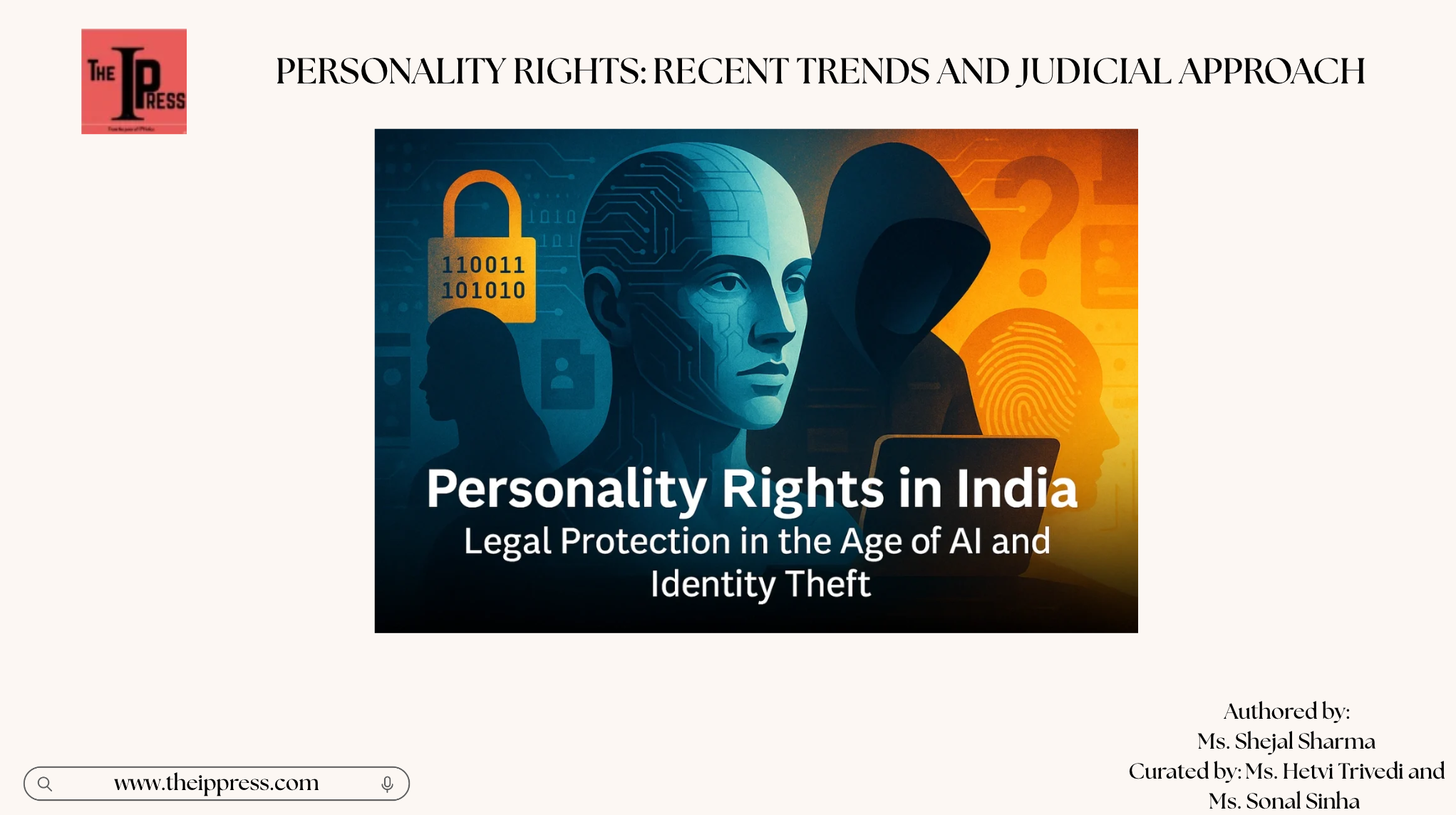
Law of Personality rights in India is still evolving. India does not have a single comprehensive status codifying the Publicity or personality rights. However, it would be rightly acknowledged that these rights have been developed through judicial interpretation in various courts, including constitutional privacy principles, common-law actions and Intellectual Property Rights (IPR). The settled principle with respect to personality rights is still narrow . The Delhi High Court has built the doctrine case by case, drawing on passing off, privacy, and the commercial value of identity, damages demanded, etc. Recently, too much of the same types of filings have been seen in the Court, particularly the Delhi high court.
For most of 2025 and early 2026 the pattern consisted of wide ex parte protection for celebrities. Although courts have increasingly extended protection to names, images, voices and other identifying attributes, the precise scope of these rights and the limits of the relief they justify still remains unsettled.
The Expansion Phase: AI, Deepfakes and “Dynamic” Injunctions
The protection of celebrity identity by the Delhi High Court has evolved in three phases: from commercial goodwill, to broad injunctions on name, voice and image, to technology-proof orders covering AI and future infringements. The initial doctrine was an extension of the doctrine of passing off, not a stand-alone right. In Titan Industries Ltd. v. Ramkumar Jewelers[1], the court held that the use of a celebrity’s identity without his consent amounts to false endorsement.
In Amitabh Bachchan v. Rajat Nagi[2], the courts awarded a wide injunction over name, voice, picture, and resemblance, as the line of orders widened. This is the time at which protection shifted from specific objects to the individual as a whole. Following that, in Anil Kapoor v. Simply Life India[3], the courts issued a ruling for the first time to address AI abuse and deepfakes, establishing that protection now extends to identity markers and technology-based identity manipulation.
In the case of Jaggi Vasudev (Sadhguru) v. Igor Isakov [4], the Court issued a “dynamic+” injunction prohibiting use of name, image, voice and likeness through AI or any technology. It reasoned that fast moving technology cannot make a plaintiff’s rights irrelevant, and that online enforcement must be visible and effective. That standard template was valid through 2026. The Court made interim orders in the matter of Dr. Sanjiv Goenka v. Google LLC & Ors. [5]and Allu Arjun vs. Frankly Retail Private Limited & Ors.[6] relating to a wide variety of digital and AI issues. The beneficiaries now include actors, cricketers, politicians, educators, and spiritual figures.
The recent case of Vijay Sai Deverakonda v. Ashok Kumar John Doe & Ors.[7]captures the intersection of both the broad scope and the constraints on the protection of personality rights. While the Delhi High Court restrained the creation of AI-generated content of Deverakonda in addition to the production of merchandise of his personality rights in the form of impersonation and obscene material, it refused to restrict the use of the term “Rowdy” in general, thus providing protection that does not extend to words associated with personality rights. The case illustrates the necessity of setting clear parameters for granting relief on personality rights.
The Pushback: “Amoebic Proportions”
The most pointed criticism was on the case of Aaradhya Bachchan v. Bollywood Time and Ors [8]. Justice C Hari Shankar said that every child, celebrity or otherwise, is entitled to dignity and respect. The suit was filed in 2023 over false content in the internet about the wellness of a child. The interim protection remained in place. On 13 August 2026, in open court, Justice Anup Jairam Bhambhani said personality rights are ‘acquiring amoebic proportions’ and asked whose rights are actually being protected. His written order brought questions rather than relief:
- Can a family name itself be intellectual property and can it become hereditary?
- Is it possible to legally protect accumulated reputation in the same way that a trademark is, and how far down the generations do such protection extend?
- Can malicious false news be a direct infringement of intellectual property or personality?
The Counsel for the Bachchans proposed that the Law of passing off protects reputation beyond ordinary trademarks protections. Judges expressed concern with applying IP rights to what essentially amounts to the tort of defamation. These observations do not advocate against personality-rights. Instead, it is an endeavour by courts to draw the doctrine’s proper boundaries. This is particularly the case in circumstances where claims against commercial identity are mixed with allegations of defamation and criticism or other forms of expressions.
Judicial Discretion in Narrowing the Scope of Relief Sought
In the Alakh Pandey v. John Doe & Ors.[9] matter, Justice Bhambhani directed the plaintiff to separate commercial or monetised use from sexually vulgar content exceeding satire, caricature, lampooning and parody. The injunction was limited to three violations: sexually vulgar portrayal, monetising the personality without a licence, and impersonation. He cautioned that these rights should not be applied so broadly that they suppress information about wrongdoing or protected expression such as parody. That caution builds on Digital Collectibles v. Galactus Funware [10], which held that use of celebrity names and likenesses for information, criticism, parody and fan expression can fall outside the right.
In Janhvi Kapoor v. Ashok Kumar/John Doe[11], Justice Bhambhani declined a blanket order over 6,884 URLs and asked counsel to tabulate them into three categories. Relief followed only for about 552 URLs that were ex facie pornographic or sexually vulgar. The direct and indirect monetisation categories were deferred. The Court is treating “personality rights” as several distinct claims rather than one. The main scope of question arises in the case was that a claim that identity has commercial value does not automatically establish that every harmful or unauthorised reference to that identity is an intellectual property infringement.
However, courts have not followed the same approach in every personality rights case. While some courts have limited relief to specific forms of infringement and protected forms of expression, others have granted broader injunctions against the unauthorised use of a person’s identity. In Khushi Kapoor v. Ashok Kumar/John Doe & Ors.[12] matter, Justice Jyoti Singh granted a single omnibus restraint against exploiting her name, image, likeness and persona, including through AI-generated content, with takedown of specified URLs within 36 hours. She relied on earlier decisions such as D.M. Entertainment v. Baby Gift House[13], Anil Kapoor[14] and Jackie Shroff[15].
The two main approaches emerging from the cases rest on:
- Omnibus line: Personality rights are one proprietary right, and one wide restraint is efficient against anonymous infringers as observed in the cases of Khushi Kapoor, Deverakonda, and the Anil Kapoor and Jackie Shroff orders.
- Narrowing line: Personality rights are several separate claims, each needing its own justification, with free speech carve-outs spelled out. This is easier to defend on appeal as observed by Justice Bhambhani.
While both approaches can protect personality rights, they differ primarily in how specifically the court identifies actionable conduct and calibrates interim relief.
Who Qualifies? Limits on the Right
In April 2026, the Court ruled in the Toprankers Edtech Solutions Private Limited & Ors. v. LPT Edtech Private Limited And Ors. [16]case that a single academic performance does not establish personality rights. It still prohibited the use of a CLAT 2026 topper’s name and photographs for defamation and trademark purposes. The right is based on the financial worth of a long-established identity, not on short-lived popularity. The case also demonstrates the Court’s search for other grounds of action when personality rights do not apply. Reading the Deverakonda, Aaradhya Bachchan, Digital Collectibles and Janhvi Kapoor cases together raises a key question: Is a person’s public stature sufficient, or must commercial value also be established?
Conclusion
Recent decisions from the Delhi High Court provide clarity on how judges interpret Personality rights that is constantly evolving. The courts have been trying to restrict the use of personality rights, while also halting a lawsuit if they are used to restrict expression. However, it seems that even when someone’s identity is utilized without their permission, mere personality rights will not prevent it. Since personality rights are yet to be defined, many courts are free to determine the extent and application of these rights and the relief depends from case to case basis. The most successful personality rights cases will find a balance between permitting individuals to defend their personalities and reputations and preserving their right to criticize others.
In the end, the court will have to decide how personality rights should be safeguarded and if they should be given different levels of protection. As of now, it is impossible to predict how these rights will evolve in the future due to the divergent viewpoints of various courts. Effectively protected and upheld personality rights are those that maintain freedom of expression. It is necessary to create a philosophy that respects each person’s right to their own identity while also being flexible enough to respond to emerging trends.
[1] 2012 SCC OnLine Del 2382
[2] 2022 SCC OnLine Del 4110
[3] 2023 SCC OnLine Del 6914
[4] 2025 SCC OnLine Del 3804
[5] CS(COMM) 395/2026 (Delhi High Court)
[6] CS(COMM) 403/2026 (Delhi High Court)
[7] CS(COMM) 1098/2026 (Delhi High Court)
[8] 2023 SCC OnLine Del 2268
[9] CS(COMM) 835/2026 (Delhi High Court)
[10] 2023 SCC OnLine Del 5206
[11] 2026 SCC OnLine Del 6408
[12] CS(COMM) – 869/2026 (Delhi High Court)
[13] 2010 SCC OnLine Del 4790
[14] CS(COMM) 652/2023 (Delhi High Court)
[15] 2024 SCC OnLine Del 3664
[16] 2026 SCC OnLine Del 1772
Authored by: Ms. Shejal Sharma