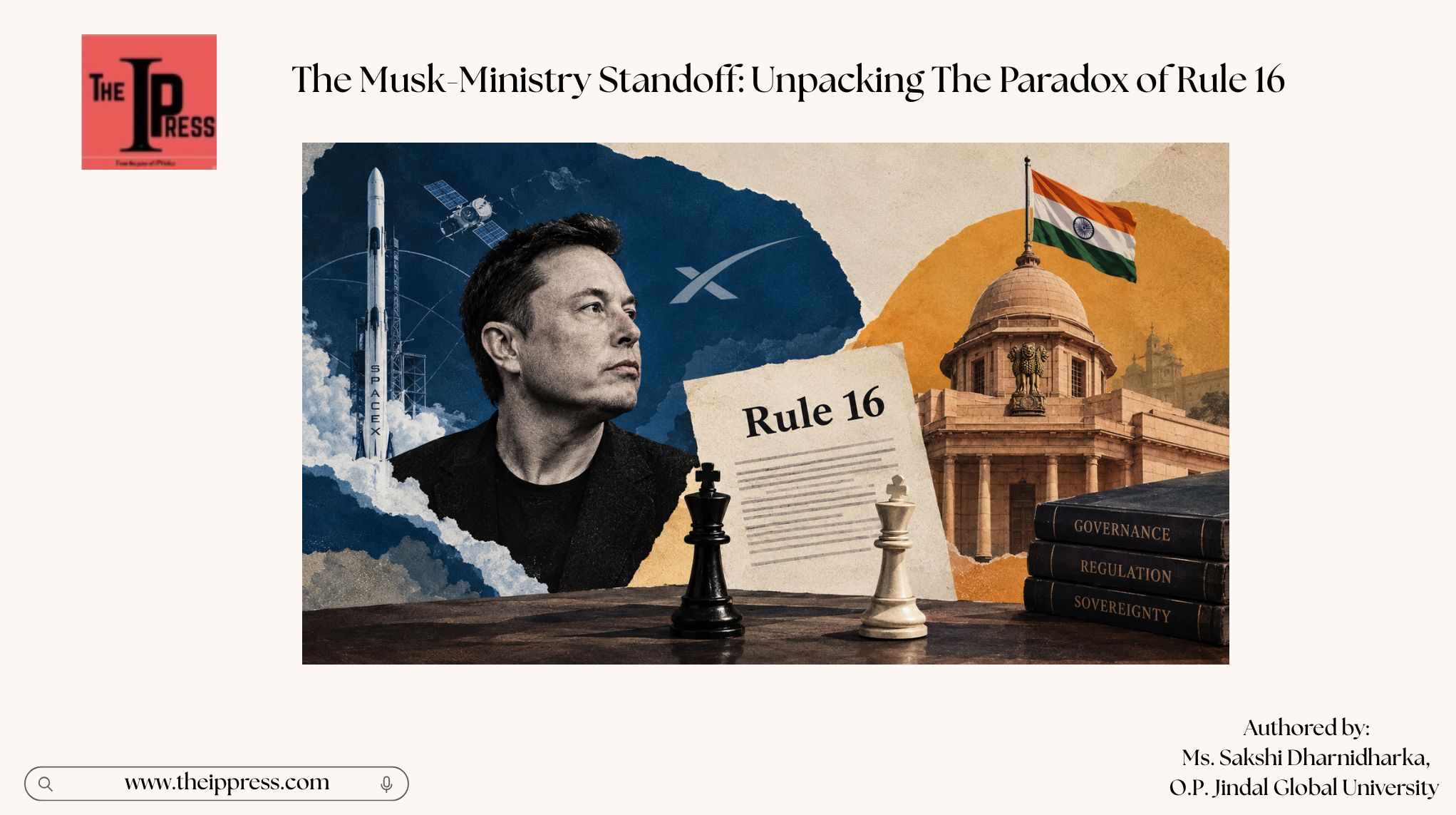
In the era where digital public spheres are increasingly being policed by state, a new flashpoint has emerged between one of the world’s largest intermediaries and the Indian government. On 15 August 2026, Elon Musk, the CEO of X (formerly twitter), released a public statement promising its users greater transparency regarding government-ordered blocking of content and takedown of tweets.
This commitment to user rights was met with an instant backlash by the Central Government who demanded that Musk’s platform strictly follow “the law of the land” and keep those requests strictly confidential. This rushed, defensive response from the government lays bare the palpable threat it experiences at the mere idea of losing its ‘veil of secrecy’ and being subjected to public and judicial scrutiny. But what exactly is this “law of the land”, and why is the government apprehensive of Musk’s move to lower the digital boundary wall?
The Anatomy Of The Gag Order: Deciphering Rule 16
The “law of the land” the Government is so fiercely defending is Rule 16 of the Information Technology (Procedure and Safeguards for Blocking for Access of Information by Public) Rules, 2009 (“Blocking Rules”). This provision functions as a statutory gag order, mandating that the intermediaries must keep any information regarding a government request for a take-down or a blocking order strictly confidential and out of public sphere.
Rule 16 essentially prevents a user from ever knowing exactly why their content was removed by the hosting intermediary. When a user’s post is deleted or their account is withheld in India, they are left entirely in the dark, unable to ascertain which specific provisions of the Information Technology Act, 2000 (“IT Act”) or the Constitution, their speech supposedly violated. Hence, Musk’s statement promising to lift this veil and increase transparency finds itself in direct, irreconcilable conflict with this Rule.
The Shreya Singhal Paradox: Façade of Procedural Constitutionalism
The absurdity of the current regulatory framework, and this Rule specifically, becomes more apparent when read in the context of the landmark Supreme Court judgment in Shreya Singhal v Union of India. In that case, the Court reaffirmed the jurisprudence around the right to access information that is warranted to the citizenry at large under the Constitution. This makes unreasonable and indefinite blocks violative of not only the speaker’s rights under Article 19(1)(a) but also of the public’s right to access information. Therefore, building on this premise, the Court declared section 66A of the IT Act as unconstitutional due to its vagueness and overbreadth.
Conversely, it upheld the constitutionality of section 69A of the IT Act specifically due to the existence of the Blocking Rules. The Court operated on the premise that these rules provided a crucial measure of procedural constitutionalism, that is an established mechanism to ensure due process and fairness, which ultimately allowed Section 69A to survive intense judicial scrutiny. However, the regulatory framework today reveals that we are living in a profound paradox. Rule 16 actively dismantles everything that the broader Blocking Rules essentially wanted to showcase in terms of procedural fairness. Wherein, the Rules mandate a pre-decisional hearing and promise audi alteram partem, the government bypasses these requirements by claiming that the originator could not be traced and shielding their decision using the confidentiality provision of Rule 16. This creates a bizarre paradox where a rule that explicitly prohibits transparency is simultaneously the very mechanism that renders constitutionality to a statutory section (69A) that is supposed to mandate reasoned orders.
The result is a system fundamentally devoid of natural justice. Thus, while a mechanism is in place for the proper removal of content, there is absolutely no appeal process available. There is not even an intimation provided to the user, the very citizen whose fundamental right is being actually affected, regarding the reasons for such punitive state action. This creates a legal catch-22 situation, as there can be no appeal of an order that is unknown to the person against whom the order is passed. The impact is not limited to the user’s right to speak, but is also extended to the collective right of the Indian citizenry to know what the government is censoring. The state’s monopoly on deciding what is readable, coupled with a lack of transparency under Rule 16, therefore creates an unconstitutional information deficit, much like the abrogated section 66A.
The New Amendment Rule And The Era of Secret Blockers
The situation is rapidly deteriorating for digital free space. Adding fuel to the fire are the newly notified IT (Amendment) Rules, 2026, which further reduce the time allotted for intermediaries to execute a content take-down from 24 to 36 hours to 3 hours and 2 hours for sensitive content. This places the intermediaries in a fix, they must remove content at breakneck speed to avoid losing their safe harbour protections under section 79 of the IT Act, all while remaining bound by the absolute silence mandated by Rule 16. This combination of the new IT amendment rules and Rule 16 creates a vicious institutional “chilling effect”. When intermediaries are forced to act faster, they tend to over comply with the government requests to avoid liability, making the intermediaries a tool for unchecked “proxy censorship”. Further, as Rule 16 prevents public accountability, the intermediaries have no incentive or fear of backlash from their users to push back against legally dubious takedown orders.
Given recent instances and an alarming increase in cases of government-sanctioned content removal on social media platforms, the problem with the status quo becomes evident. In this context, a public commitment to transparency from the CEO of one of the biggest platforms for user content is incredibly bad news for these ‘secret blockers’ within the state apparatus. It threatens to expose the potentially arbitrary nature of these takedown notices, which have long been shielded from public and judicial scrutiny by the cloak of Rule 16.
The Judicial Horizon: The Challenge To Rule 16
This regime of enforced silence under the disguise of state confidentiality is not going unquestioned. The constitutional validity of Rule 16 has been formally challenged by the Software Freedom Law Centre (SFLC), and this matter is currently sub judice before the Supreme Court. As the tech community and free-speech advocates defend the sanctity of the digital space, the outcome of this litigation will likely shape the future of digital freedom, government accountability and the limits of intermediary transparency in India.
Authored By: Ms. Sakshi Dharnidhar
Ms. Sakshi Dharnidhar is a final year law student at O.P. Jindal Global University with a keen interest in Intellectual Property and Technology, Media and Telecommunication Law.
