Introduction
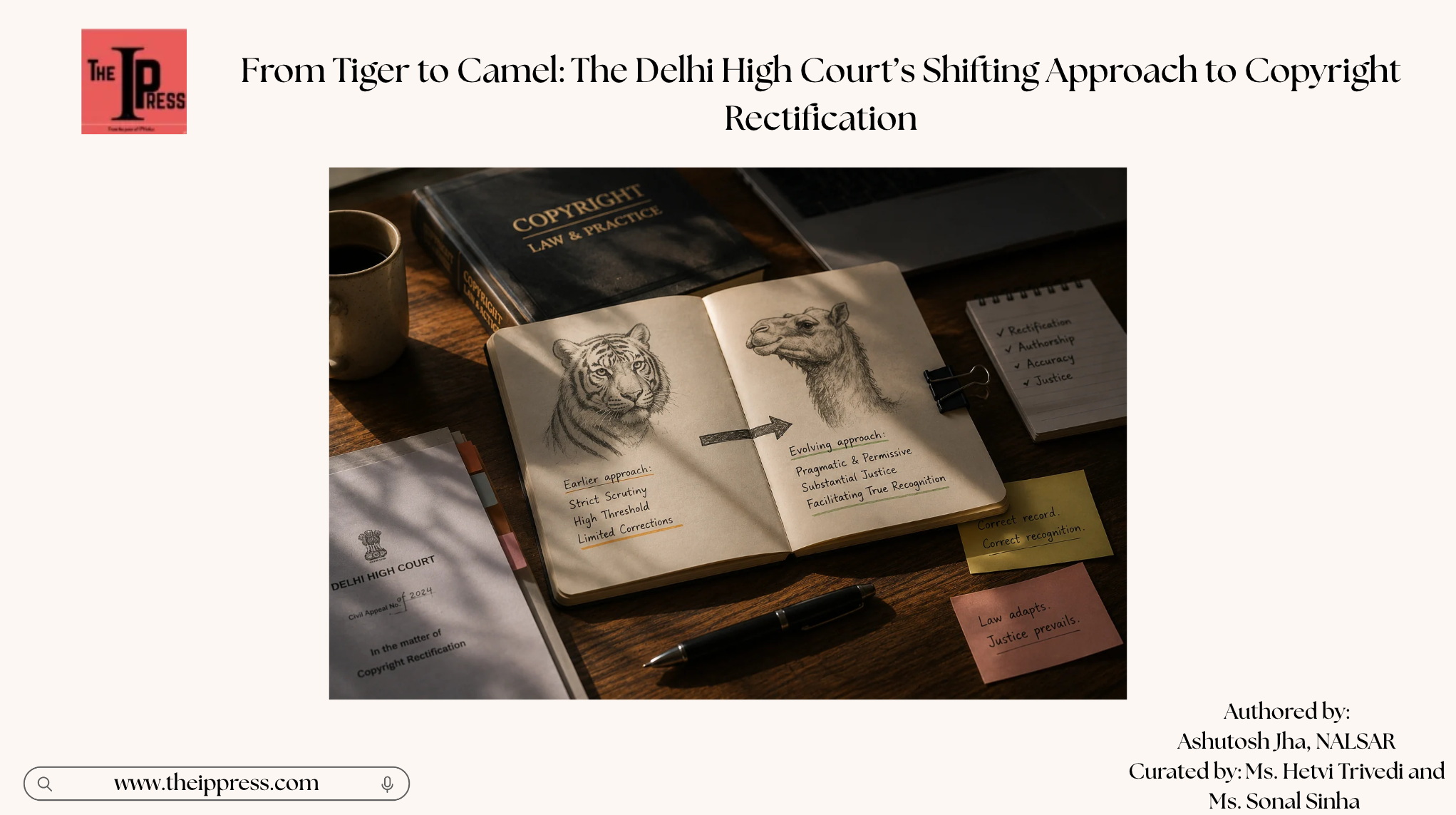
One of the commendable features of Indian copyright law is its anticipation of misuse of registration. Section 45 of The Copyright Act, 1957 codifies this under the proviso to sub-section (1), which demands a clearance certificate from the Trade Marks Registry before allowing the registration of an artistic work usable on goods. Further, Section 50 empowers the High Court to remove any entry wrongly made or wrongly remaining on the register.[1] However, in Japan Tobacco Inc. v. The Central Wearhouse, the Delhi High Court left a registration untouched only because the challenging party could not prove first ownership over the concerned artwork.[2] Through this blog, the author argues that the Court asked the wrong question when it required the petitioner to prove its own first ownership. A rectification petition tests the validity of the registration, not the petitioner’s title. On this question, the Court left the originality enquiry and the Section 45 safeguard unexamined, the same enquiries that the Court considered decisive in an earlier ruling.[3]
Background
Japan Tobacco Inc. and its affiliate petitioned the Delhi High Court under Section 50 to remove a 1997 copyright registration for the CAMEL and CAMEL COLLECTION artistic work, held by the garment company The Central Wearhouse. The petitioners submitted that the CAMEL device mark could be traced to a 1913 cigarette label created for R.J. Reynolds.[4] They relied on an Indian registration for CAMEL dating to 1946 and on foreign registrations for CAMEL COLLECTION from 1988 onwards.[5]
The respondent’s work was registered in 1997, naming Mrs. Veena R. Hinduja as author and claiming first publication in 1992.[6] The publication year is significant. In 1992, the petitioners’ German garment licensee outsourced manufacturing to Gokaldas Exports, a sister concern of the respondent in which Mrs. Hinduja was a director and shareholder.[7] On this basis, the petitioners argued that the respondent’s label superimposed their artworks, lacked originality under Section 13, and was registered without the certificate required under Section 45(1).[8]
The respondent conceded that it had no documentary proof of how the work was conceived. Its witnesses stated that the label was designed in Gokaldas’ internal design department.[9]
The Judgment
Gedela J. framed the core issue as the establishment of originality in the artwork. It was held that a person claiming copyright must establish as a fact that they are the first owner of the copyright under Section 17, and that a trademark registration may lend credibility but is not sufficient.[10] The brand-history books submitted by the petitioner as evidence of the 1913 creation were not held sufficient either.[11] Since this initial burden was not discharged, it never shifted to the respondent, and Section 48 raised a presumption in the respondent’s favour.[12]
Section 40 and the International Copyright Order, 1999, both of which enable foreign works to get protection in India, were held to be not enough to fill the gap.[13] The Court further observed that the objections under Section 45(1) and Rule 70 of the Copyright Rules, 2013 were merely “academic” and did not examine any of the precedents cited in support of the same.[14]
Standing is Distinct from Title
The above decision is not consistent with what rectification provisions ask for. Section 50 of the Copyright Act asks only whether an entry in the register has been wrongly made or wrongly remains.[15] The only condition it sets for the petitioner is that it must be a person aggrieved. This condition, however, is a question of standing which is distinct from a question based on merits.
On standing, the Court in effect demanded more than its own precedent requires. In Fortune Marketing v. Gujarat Pesticides, Jyoti Singh J. held that the registered proprietor and prior user of a mark subsumed in an impugned work has a “real and tangible interest” and is a person aggrieved.[16] No proof of first ownership of copyright was demanded. Japan Tobacco has held an Indian CAMEL registration since 1946, and the Court never ruled on the respondent’s objection to its standing.[17]
The Entry was Wrongly Made, Whoever Owns the Art
It is a foundational principle that copyright subsists only in original works.[18] If the CAMEL COLLECTION label was copied from pre-existing art, the registration is wrong no matter who owns the original art. Such a registration would be invalid even if the petitioner’s art had long entered the public domain. The core question was whether the work originated from the registered author and owner, and the Court never asked the respondent to answer this question even after the latter’s concession that it had no record of the work’s conception.[19]
Further, in Heineken Asia Pacific v. Vijay Keshav Wagh, decided in March 2026 by the same Judge, the Court expunged a registration because the work itself was a copy and not an original work.[20] In this case, the petitioner’s Indian and foreign trade mark registrations, with dates of use, were held capable of constituting dates of publication of the logo.[21] Japan Tobacco relied on similar material, namely its earlier trade mark registrations, but the Court found it insufficient without explaining the departure from Heineken.[22]
There are distinctions when it comes to the Heineken case. In Heineken, the respondent’s right to file a reply was closed, so the petitioner’s submissions stood unrebutted.[23] Here, the respondent formally denied the petitioner’s evidence.[24] The respondent also relied on separate trade mark proceedings between the parties over the CAMEL mark. It stated that the Registrar of Trade Marks, the Intellectual Property Appellate Board and the Madras High Court had upheld its priority over the petitioner, and that an appeal was pending before the Supreme Court.[25] On this basis, the respondent contended that its claim to the CAMEL mark in India was earlier than Japan Tobacco’s. The contested evidence and the trade mark rulings may justify caution about whether Japan Tobacco owns the 1913 artwork. However, they do not explain why the respondent’s originality and the Section 45 defect went unexamined, since neither question depends on Japan Tobacco’s title.
The Court’s reliance on Section 48 exacerbates the problem. The Section makes the Register prima facie evidence of the particulars entered in it.[26] Invoking this presumption to defeat a petition whose objective is to prove that the entry should not have been made allows the challenged entry to be its own validator. A prima facie presumption can allocate the burden of rebuttal, but it should not carry so much weight where the petitioner alleges a defect in how the entry itself was made.
Section 45 Proviso is Not Academic
The proviso to Section 45(1) mandates that an application to register an artistic work used or capable of being used in relation to any goods or services must be accompanied by a certificate from the Trade Marks Registry stating that no identical or deceptively similar mark has been registered, or applied for, in another person’s name.[27] It has been in force since 1984 and applied when the impugned entry was made in 1997.[28] Its condition is not tied to ownership and asks only whether a conflicting mark exists on the register. The Delhi High Court has described its purpose as preventing parties from copying label marks and hiding under a false claim of copyright ownership.[29] In Fortune Marketing, an inaccurate certificate was held enough in itself to set aside a registration.[30] In Heineken, the Trade Marks Registry’s inability to cite the TIGER mark meant that the Copyright Registrar never had the chance to inquire into originality.[31]
These holdings show that this issue cannot be academic. The certificate is what equips the Registrar of Copyrights to conduct the inquiry as laid down in Section 45(2).[32] If there was no certificate, or it was issued despite the CAMEL label present in the register since 1946, the entry was made without the inquiry that the statute requires, making it an erroneous entry regardless of who owned the 1913 artwork of the petitioner. Since the proviso is not limited to the same class, a Class 34 registration for cigarettes cannot be held irrelevant for garments.[33] Therefore, the Court’s treatment of first ownership as a threshold has made a statutory safeguard depend on the very question that the safeguard was designed to make unnecessary.
A Separate Question on Respondent’s Ownership
Section 17 raises a separate and independent question about the respondent’s own title. On the respondent’s own evidence, the label was made by employees in Gokaldas’ design department.[34] However, Section 17(c) makes the employer the owner of the copyright in any work originating during the course of employment, unless there is an agreement to the contrary.[35] This would make Gokaldas, not Mrs. Hinduja or the respondent, the first owner, since no agreement to the contrary was produced. Therefore, the authorship details on the Register appear inconsistent with the registrant’s own evidence. This is an error that can be corrected under Section 50(c).[36]
Conclusion
Copyright registration is fast and is comparatively leniently examined, which is why the proviso to Section 45(1) exists. If a rectification petitioner must first prove its own title, the originality inquiry and the Section 45 safeguard are never reached. A sounder approach would treat ownership as a question of standing, and test the validity of the registration on the registrant’s originality and compliance with Section 45.
[1] The Copyright Act, 1957, Section 45(1) proviso, Section 50(b).
[2] Japan Tobacco Inc. v. The Central Wearhouse, C.O.(COMM.IPD-CR) 814/2022, (Delhi HC, 5 October 2026), Paras 30–31.
[3] Heineken Asia Pacific Pte. Ltd. v. Vijay Keshav Wagh, CO(COMM.IPD-CR) 18/2023, 2026:DHC:1932, (Delhi HC, 10 March 2026), Paras 27–29.
[4] Supra note 2, Paras 5, 21.
[5] Supra note 2, Para 4.
[6] Supra note 2, Paras 1, 4.
[7] Supra note 2, Paras 11.1, 11.12.
[8] Supra note 2, Paras 9, 11.6, 11.7, 11.14.
[9] Supra note 2, Paras 12.10, 12.13.
[10] Supra note 2, Paras 15, 18.
[11] Supra note 2, Paras 22, 23.
[12] Supra note 2, Para 23; The Copyright Act, 1957, Section 48.
[13] Supra note 2, Paras 20, 21, 24; The Copyright Act, 1957, Section 40; International Copyright Order, 1999.
[14] Supra note 2, Paras 32, 33.
[15] The Copyright Act, 1957, Section 50.
[16] Fortune Marketing Pvt. Ltd. v. Gujarat Pesticides, C.O.(COMM.IPD-CR) 24/2024, 2026:DHC:4850 (Del HC, 29 May 2026), Paras 20, 22, relying on Hugo Boss Trademark Management GmbH & Co. KG v. Sandeep Arora, 2023 SCC OnLine Del 7956.
[17] Supra note 2, Para 4. The respondent stated that this registration is presently under rectification and objected to the petitioner’s locus: Paras 12.5, 12.10.
[18] The Copyright Act, 1957, Section 13(1)(a); see Eastern Book Co. v. D.B. Modak, (2008) 1 SCC 1.
[19] Supra note 2, Para 12.10.
[20] Supra note 3, Para 29.
[21] Supra note 3, Para 25.
[22] Supra note 2, Paras 4, 18.
[23] Supra note 3, Paras 14, 24.
[24] Supra note 2, Para 23.
[25] Supra note 2, Para 12.15.
[26] The Copyright Act, 1957, Section 48.
[27] The Copyright Act, 1957, Section 45(1) proviso. For the procedure applicable in 1997, see the Copyright Rules, 1958, Form IV, Statement of Particulars, item 13A; the current equivalent is the Copyright Rules, 2013, Rule 70(6).
[28] Inserted by the Copyright (Amendment) Act, 1983 (23 of 1983), Section 16, w.e.f. 9 August 1984. In 1997 the proviso read “in relation to any goods” and referred to the Registrar under Section 4 of the Trade and Merchandise Marks Act, 1958. The words “or services” and the reference to Section 3 of the Trade Marks Act, 1999 were substituted by the Copyright (Amendment) Act, 2012 (27 of 2012), Section 31, w.e.f. 21 June 2012.
[29] Supra note 16, Para 20, citing Hugo Boss, 2023 SCC OnLine Del 7956; see also Marico Ltd. v. Jagit Kaur, 2018 SCC OnLine Del 8488; Supra note 3, Para 27.
[30] Supra note 16, Paras 21, 23, 24.
[31] Supra note 3, Para 28.
[32] The Copyright Act, 1957, Section 45(2).
[33] Supra note 2, Paras 4, 12.2.
[34] Supra note 2, Para 12.13.
[35] The Copyright Act, 1957, Section 17(c).
[36] The Copyright Act, 1957, Section 50(c).
Authored by Mr. Ashutosh Jha, NALSAR University of Law, Hyderabad