

Introduction:
In today’s digital commercial place, where products have the same engagement as on shelves, the distinction between artistic expression and brand identity becomes blurry. Now, colour, webpage layout, and interface designs direct the consumer behaviour as strongly as physical logos once did. Although India’s Intellectual Property laws are still regulated within a framework built for the physical era.
The gap was visible in EBC Publishing Private Limited v. Rupa Publications, In this case, the dispute arose over a red colour resembling a red black cover design of a pocket-sized book design of the Constitution of India. The simple cover design, text, and colour became the area of legal scrutiny. The Delhi High Court injunction exposes a gap in how copyright and trade dress operate when a visual identity is alleged to be copied with question arising on application of law to digital formats such as web layout, e books and app interfaces which further highlights the interplay of copyright and trade dress in the digital protection of creative and commercial identity. However, beyond this case, the question arises how these protections can be read when visual identities evolve into digital formats, web page layouts, e-book covers and app interfaces?
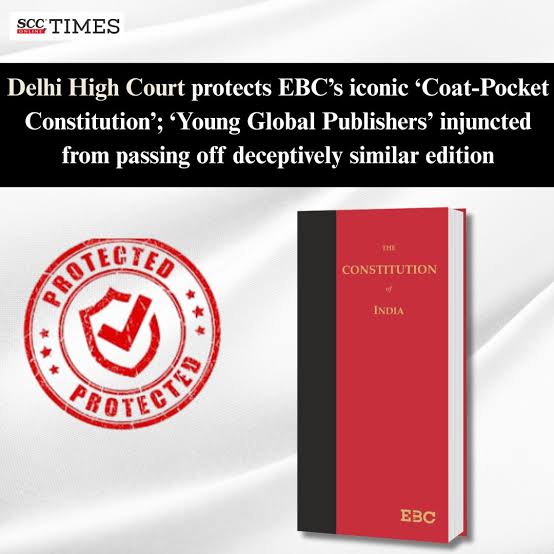
While Sections 13, 14, and 51 of the Copyright Act, 1957 protect original artistic expression and, passing off principle under the Trademark Act, 1999, safeguarding imitation and misrepresentation they don’t address the fluidity of visual identity in the digital era.
This discussion thereby examines how Indian IP law must be changed to recognise the digital overlap between design, creativity and consumer perception where confusion can occur in milliseconds.
Cover designs and Creative safeguard: how artistic work qualifies under Copyright Act, 1957.
Section 2(c) of the Copyright Act, 1957 defines “artistic quality,” to include painting, drawing, engraving or any work that possesses the quality to be eligible under this expression, is to be protected. It is divided into two elements: firstly, the functional features, which means the idea or an expression dictated by necessity and practical usage. Secondly, expressive features involve the creative side of any work, reflecting artistic value and originality. therefore, the law does not protect the idea or any function but the real expression of that idea.
In Eastern Book Company v. D.B. Modak, the Supreme Court has highlighted, a minimum threshold of originality with the “Skill and Judgement Test”. For any work to come under a minimum degree of creativity, sufficient labour, capital, and skills must be invested. For example, EBC has invested sufficient financial resources in the publication process, and its red-black color scheme constitutes a distinct creative identity. For a product or design to be protected under copyright, the condition of functionality relating to originality of work, and expressive persistence with creativity of its design, needs to be fulfilled.
Section 13 of the Copyright Act, 1957 act provides subsisting copyright protection to literary and artistic expressions without mandatory registration of their designs which includes book covers and their other expression. Further, section 14 provides the copyright owner exclusive rights on copyrighted products including reproduction, and communication to the public, which restricts any third party from using, copying or imitating any protected expression or form, additionally these rights apply particularly to creative aspect of work ensuring that only original owner controls their use. But these rights, however are not absolute; it is limited by Section 51 by requiring a qualitive assessment of copying.
About the question of infringement under section 51, the substantial test was applied, established in the case of R.G Anand v. Deluxe films & Ors.(1978), which includes:
1. Whether plaintiff’s work is a reproduction of defendant’s original work,
2. To what extent this work is materially or substantially copied from original work.
Additionally, volume, subject matter, intention to steal (“animus furandi”), and extent of copying needed to be proved. It focused on the qualitative prominence of any work, which means the distinctive part of a work that adds overall novelty. It is also defined in the impression test under R.G. Anand v. Deluxe Films, which, quoting Hanfstaengl v. W.H. Smith held that “a copy is that which comes so near to the original as to give to every person seeing it the idea created by the original“. Thus, an infringement occurs when a viewer gets the unmistakable impression that work has been copied, underscoring the qualitative role of “What is taken rather than how much is taken”. This qualitative lens is important in the digital era, where small modifications in layout and proportion can be manipulated to escape infringement and still get the same consumer impression.
Extracting the gap; evolving digital commercial identity and its protection in IPR.
The traditional IP framework is generally grounded in physical products. But the arrival of digital logo including entire gamut of digital product layouts which is understood as digital trade dress and it is the broader digital visual part rather than just logos which requires clear legislating on recognition and protection. Now, color schemes, shapes, e-books, app webpages, and layout fonts are covered under digital trade dress. For example, the government of India reserved its colors, icons, and framework required for a digital platform for the government site. It is made under the Digital Brand Identity Manual (DBIM), which includes a domain of making exclusive logos or web pages with specific reserved tools. While the pertinent acts protecting trademark or copyright are mainly based on an offline contextual system. A legislative gap arises when the digital variant of the same logos cannot be applied for penalty or injunction based on size, font scheme, and other minute details.
Even though such minor differences often result from screen resolution and font adjustment and it will be covered under De minimis principle, as these infringements are narrow or small to constitute infringement. But when the variation is deliberately made, it can mislead and confuse consumers. The same logo may appear in different sizes and shapes when seen from mobile or laptop devices. Consequently, it becomes difficult for ordinary consumers to notice such changes. Other jurisdictions such as U.S.A, have resolved this gap through their digital legislation. For instance, in judicial precedent of Apple Inc. v. Samsung Electronics (2012), U.S. Federal Circuit held that digital app interface, pages, icons and designs can be protected under IP law. Under the U.S Patent Protection Act, the Graphical User Interface (GUIs) qualify as ornamental designs for an Article of Manufacture under Section 171. Simultaneously under Section 43(a) of the U.S Trademark (Lanham) Act, 1946 where the interface appearance works as source identifying trade dress, protecting digital trade dress including the appearance of any interface, icons and layout on basis of their distinctiveness and non-functionality. Thereby, the decision recognized software interfaces as a form of visual design applying a look and feel test in the interface.
In India, there is no particular statutory provision that regulates digital trade dress and GUIs. Additionally, the subject matter of trade dress is not explicitly mentioned under the Trade Dress Act, 1999. Instead, elements such as shapes and colour combinations are protected under the broad definition of trademark and through common law action such as passing off, although the extension of such protection to digital interfaces remains uncertain, underscoring a gap in Indian IP law regarding clear protection of graphical user interfaces and other digital layouts.
However, in some cases, similarity or consumer confusion tests become ineffective as no prior standard is set for ascertaining the digital difference, as there is no such provision legislated in terms of applying this in digital forums. For example, physically, courts apply the consumer recollection test when deciding whether the average person, in terms of intelligence, with imperfect memory, will be able to distinguish between two trademarks. While both digital and physical contacts include momentary consumer impression but in digital presence, users generally see and scroll logos and webpages rapidly. Unlike in a case of a supermarket, where the chance of repetition is more probable and reinforces a brand recall. Online interactions occur in milliseconds, making consumers more prone to confusion and misleading affiliation.
Possible remedies in Copyright and trade dress for Virtual protection.
To bridge this gap, a proper structure that solves the digital confusion is needed. Firstly, a framework where section 2 of the Trademark Act, 1999, can define a graphical user interface in its language, recognising the growing role in product distinctiveness. Secondly, the Design Act, 2000, can be amended to include graphic layout for ebooks, designs, or logos. this work serves as an initial step in determining rights, protection, and penalties for infringement of designs on digital forums. Finally, creating a digital commercial registry where owners of logos can deposit them so they can be presented as evidence in court. This will help in reducing the uncertainty of the existing legal gap in digital trademark protection.
Similarly, extending section 13 of the Copyright Act, 1957, to include digital layouts and graphical interfaces under “artistic works.” This would make provisions of infringement under sections 51 and 55 automatically applicable to digital visual identity. Further, stopping public display of GUI and providing monetary relief for unauthorised use under section 55(1) of the Copyrights Act is automatically applicable to digital visual identity.
By combining these reforms with the made analysis, one can ensure the protection of creativity and clarity in consumer minds. It reflects the essentiality of change in Intellectual property in a digital sphere where the economy or businesses largely shift towards virtual branding and visual representation.
Conclusion:
The progressing digital market laid out clear gaps in India’s copyright and trade dress framework; it still works under a physical world logic. As observed in the EBC v. Rupa dispute, even simple color layouts possess source identification value, but the law does recognize the extended digital variation of these same and the speed at which this confusion occurs. The app layouts, webpages, and digital interfaces present a new visual identity, as existing tests of substantial and consumer recollection tests are inadequate for millisecond-level online interaction of any individual. Therefore, recognizing GUIs, expanding protection of design, and regulating a digital commercial registry are necessary; without them, Indian IP laws and frameworks are at risk of underprotecting creativity.
Mr. Nikesh Dubey is a third-year B.A. LL.B. (Hons.) student at Dharmashastra National Law University, Jabalpur. He has a keen interest in Intellectual Property Law, particularly in the areas of copyright and trade dress, and regularly writes on contemporary legal developments